


Erectile dysfunction (Impotence) and urinary incontinence after urological surgeries. Prostate cancer. Radical Prostatectomy.
Prostate cancer (Prostatic carcinoma) is one of the most common malignant neoplasm occurring in men. It occurs mainly in men over age 50.

Early detection of prostate cancer – in the stage when the tumor is confined within prostate ("early prostate cancer"); when the metastatis is not present yet – guarantees great after surgery effects. The chance of surviving the 10 years after the operation is estimated at 85%!
The surgery with the entire prostate removal (including the seminal vesicles) caused by the tumor is called radical prostatectomy.
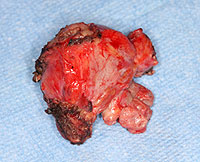
Radical prostatectomy can be conducted in a classic manner, by "opening the body" (retropubic approach or perineal approach), with the use of laparoscope (laparoscopic prostatectomy) or with the use of daVinci robotic system (robotic-assisted laparoscopic radical prostatectomy - RALRP). The results of all presented methods are very similar and their effectiveness depends mostly on the experience and preference of the surgeon.
Unfortunately, despite the medicine’s progress and more refined methods, the prostatectomy’s main side effects are erectile dysfunction (ED) and urinary incontinence. These particular disorders occur not only after the prostate removal (radical prostatectomy), but also after radiotherapy of prostate cancer (External beam radiotherapy or brachytherapy) and after surgical intervention within the pelvic area (surgical resection of rectal cancer).

*The vascular bundles and nerves after the prostate removal (kept in the reins) done by bipolar method; one of them is wrapped a special dressing.
If the radical prostatectomy is conducted with the Nervi erigentes saved bilaterally, the chances for erection regaining are estimated at about 50%; in case of unilaterally saved nerves, the maximal chances are at about 30%. The chances for erection regaining (penile rehabilitation) are increased among younger patients and the regeneration can last up to 3 years.
In order to understand the mechanism of the incontinence after the radical prostatectomy, it is important to know, that when the prostate is removed and the urethra is connected back again with the urinary bladder, a completely different anatomic situation is created in the area of the lower pelvis. Despite the fact that after radical prostatectomy, the external urethral sphincter (responsible for urinary continence) remains untouched, almost 90% of patients right after the operation, suffers from the urinary incontinence. This is the very reason why an effective rehabilitation is required right after the surgery as the incontinence in such cases can be treated, but (!) only in the period of first 18 months from the operation. . It is worth to mention about common transurethral prostate surgeries (in cases of slight prostate enlargement), when a very severe and irreversal damage is done to the external urethral sphincter. In such cases, only the surgery can be of any help and the effectiveness of the rehabilitation will depend on the severity of the damage done to the muscle.
* The photographs came from the thesis by: Przybyla A: "Comparison of monopolar versus bipolar radical retropubic Prostatectomy. Complications and Morbidity. Georg-August-Universität Göttingen, Germany 2012"
Early detection of prostate cancer – in the stage when the tumor is confined within prostate ("early prostate cancer"); when the metastatis is not present yet – guarantees great after surgery effects. The chance of surviving the 10 years after the operation is estimated at 85%!
The surgery with the entire prostate removal (including the seminal vesicles) caused by the tumor is called radical prostatectomy.
Radical prostatectomy can be conducted in a classic manner, by "opening the body" (retropubic approach or perineal approach), with the use of laparoscope (laparoscopic prostatectomy) or with the use of daVinci robotic system (robotic-assisted laparoscopic radical prostatectomy - RALRP). The results of all presented methods are very similar and their effectiveness depends mostly on the experience and preference of the surgeon.
Unfortunately, despite the medicine’s progress and more refined methods, the prostatectomy’s main side effects are erectile dysfunction (ED) and urinary incontinence. These particular disorders occur not only after the prostate removal (radical prostatectomy), but also after radiotherapy of prostate cancer (External beam radiotherapy or brachytherapy) and after surgical intervention within the pelvic area (surgical resection of rectal cancer).
*The vascular bundles and nerves after the prostate removal (kept in the reins) done by bipolar method; one of them is wrapped a special dressing.
If the radical prostatectomy is conducted with the Nervi erigentes saved bilaterally, the chances for erection regaining are estimated at about 50%; in case of unilaterally saved nerves, the maximal chances are at about 30%. The chances for erection regaining (penile rehabilitation) are increased among younger patients and the regeneration can last up to 3 years.
In order to understand the mechanism of the incontinence after the radical prostatectomy, it is important to know, that when the prostate is removed and the urethra is connected back again with the urinary bladder, a completely different anatomic situation is created in the area of the lower pelvis. Despite the fact that after radical prostatectomy, the external urethral sphincter (responsible for urinary continence) remains untouched, almost 90% of patients right after the operation, suffers from the urinary incontinence. This is the very reason why an effective rehabilitation is required right after the surgery as the incontinence in such cases can be treated, but (!) only in the period of first 18 months from the operation. . It is worth to mention about common transurethral prostate surgeries (in cases of slight prostate enlargement), when a very severe and irreversal damage is done to the external urethral sphincter. In such cases, only the surgery can be of any help and the effectiveness of the rehabilitation will depend on the severity of the damage done to the muscle.
* The photographs came from the thesis by: Przybyla A: "Comparison of monopolar versus bipolar radical retropubic Prostatectomy. Complications and Morbidity. Georg-August-Universität Göttingen, Germany 2012"